
About a year ago, I wrote about Chess-Wars. A Game I put modified from an original idea created by White Mask Games in their Tokar’s Arcana. The Company, White Mask Games has since disappeared form the internet, and for years I have not been able to find their website that used to be there.
I will create a separate Article about Tokar’s Arcana at a later date. They deserve that.
In Chess War, the idea is that you are able to pit the armies of different Chess Variants against each other. This gave me giggles when I originally thought about fighting FIDE Chess (International Chess) against some of the cultural variants, like Chinses Chess (Xiang Qi), or Japanese Chess (Shogi). and so that was what I began working on. The rules needed to play these armies against each other. and the files you could use to do so with your own Chess sets.
To play Chess War, two players each choose an army. Over the next several Weeks I will be uploading armies here and their cultural rules, as well as how to use in Chess Wars.
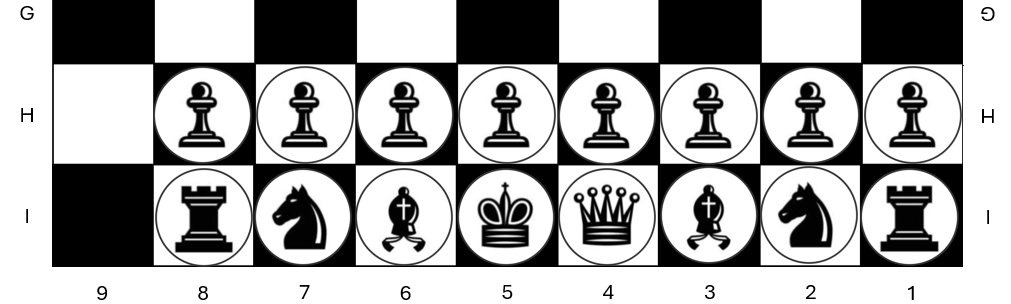
If one of the armies normally are played on a larger board than the standard 8×8 chess board, then you will need the larger board. The smaller army will place their pieces in their regular spaces starting from the A1 corner of the board.
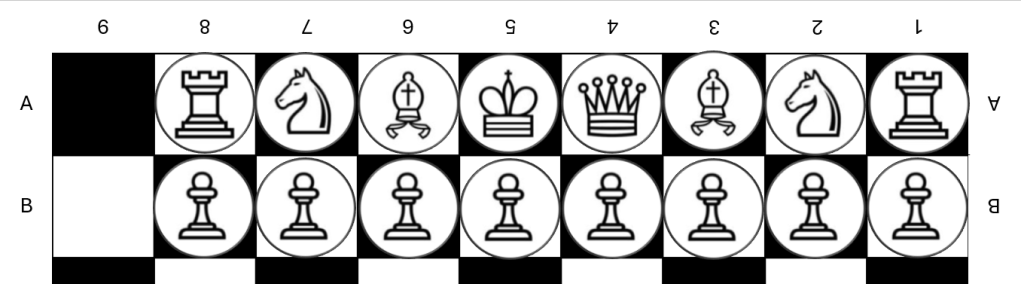
Alternatively they may be on the far end of the board, but Must always begin at the 1st Column.
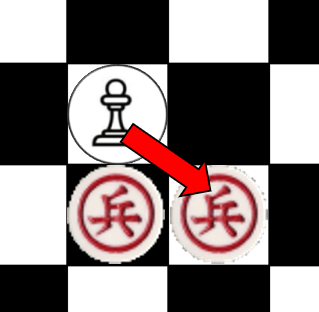
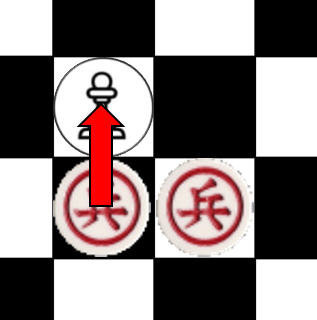
Chess Wars pieces will move the same as they would in their original game. So some armies may have the same pieces, but they move differently. Pawns are an example of this. In the pictures the FIDE Pawn may capture the XiangQi Pawn diagonally from it. But the XiangQi Pawn capture directly in front of it.
Some Armies will have special rules that will make them more difficult to compete against, for example: In Shogi, you may recruit captured pieces into your army and just drop them into the board. A FIDE Chess army could be facing an army of their own turncoat friends.
The end result of the game however, stays the same. Usually this involves capturing either, the King piece (Or equivalent) of the other army. There are special cases to this, and they will be explained in those army sets.
Ranks
Ranks are a way to organize the armies. Some pieces in an army may only be effective against certain ranks. Jungle Chess for example, the pieces may only capture a lower Rank. From lowest to highest the ranks are
- Soldiers – The simplest soldiers in the army. They have 1 move.
- Lieutenant – Rooks fall into this Rank. Powerful warriors
- Sergeant – Knights fall into this Rank. Hard to follow pieces
- Captain– Bishops fall into this Rank.
- Chief – Queens fall into this Rank.
- General – The ruler. The most important piece.
It is theoretically possible to have different pieces in an army that have the same rank. To do this you must have a way to differentiate between the pieces. The easiest way is to have a 2nd set of similar, but slightly different chess pieces ready to use. Other ways may include magnetizing a coin to the bottom of the piece or putting a washer over the top.
Each piece will be described in the Army page, by first stating the name, and rank, then their Strength.
Army Strength
Army strength is a numeric value that expresses how hard the army is to fight. The higher the stronger.
Strength is not connected to Rank.
To calculate the strength you must count up points for the pieces.
- +1 point for each piece that moves only 1 space for each direction.
- +2 points for each piece that moves only 2 or 3 spaces.
- +3 points for each piece that has unlimited movement orthogonally.
- +3 points for every piece that has unlimited movements diagonally.
- +1 for every piece that may be promoted.
- +1 for each piece that may Leap over other pieces.
- +5 Points for the General if his capture ends the game.
- +1 for every extra method of capture a piece may have.
Chess
Chess refers to the FIDE international Rules of Chess. All other versions will go by other names in Chess Wars. The History of Chess is long and varied, but the rules we play with today were standardized in the 19th century. This is about the same time that there began international competitions in chess, and the two are connected. It was during this time, that moves like castling and en passant were standardized.
Board: Chess is played upon an 8×8 checkered board. The grid on the board is filled in with alternating colors to create the checkered effect. Spaces are numbered 1~8 Horizontally, and lettered A~H Vertically. This allows players to plan out moves or to play through distance, and once upon a time playing Chess by mail (snail mail) was a common practice. the games would take a very long time to play.
Army: 16 pieces, Strength: 64
1 King (King), 1 Queen (Chief), 2 Bishops (Captains), 2 Rooks (Lieutenants), 2 Knights (Sergeants), 8 Pawns (Soldiers)
How to Lose: A Chess Army loses if their King piece is put into Check-mate, a situation where it cannot move without being captured, or if it is captured.
Pieces:

Pawns (Pawns): (Strength: 32)
Pawns are the foot soldiers of the Army. They typically wear little to no armor and carry swords. Pawns are the soldiers sent in to test the waters of battle, or are sent to swarm over the battlefield and overwhelm the enemy.
Move: Pawns move 1 space vertically forward (never backward) (+1 Strength each)
1st Move: May move 2 spaces forward on the first move ONLY. (+1 Strength each)
Capture: Pawns capture a piece by moving diagonally 1 space forward onto the enemy piece.
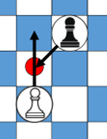
En Passent: If another pawn moves 2 spaces (See 1st Move), and lands next to an enemy pawn. The enemy pawn may move diagonally to land behind the pawn and capture it. (+1 Strength each)
Promotion: If a pawn reaches the last space on the far side of the board, it can be promoted to any piece the player currently has in their captured collection. (+1 Strength each)


Rook: (Lieutenant) (Strength: 6)
Rooks are the war chariots of the battlefield. They are fast and deadly.
Move: Rooks move any number of spaces orthogonally (Straight forward or Backwards, or Sideways). (+3 Strength each)
Capture: If a rook moves onto another piece during its move, that piece is captured. No special movement required.
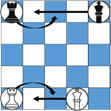
Castling: If neither Rook nor King have been moved, AND there is no pieces between them, they may both move at the same time. When they move, the two pieces go half way and flip sides.


Knight: (Sergeant) Strength: 6
Knights are the soldiers in shining armor. They ride into battle on horses also clad in shining armor. They gallop around the field and move easily through the crowds.
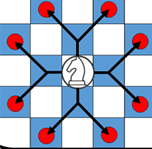
Move: Knights move 1 space orthogonally THEN 1 space diagonally. (+2 Strength each)
Leaps: Knights may leap over pieces when they move. (+1 Strength each)
Capture: If a knight moves onto another piece during its move, that piece is captured. No special movement required.


Bishop: (Captain) Strength 6
Bishops are the religious leaders that advise the King on strategy. They can be swift and deadly in their attacks, but being men of god, they can also be quite predictable.
Move: Bishops move any number of spaces in a diagonal direction. (+3 Strength each)
Capture: If a bishop moves onto another piece during its move, that piece is captured. No special movement required.


Queen: (Colonel) Strength 6
The Queen is The Kings wife, and the one who is by his side through everything. She works hard to make sure her husband is successful in his wars.
Move: The Queen moves any number of spaces in a straight direction (diagonally or orthogonally). (+6 Strength)
Capture: If a queen moves onto another piece during its move, that piece is captured. No special movement required.


King: (King) Strength 8
The King is the most important piece on the board for each player. If the King is captured, the game ends. He is the avatar of the player, and is in charge of making all decisions related to the war.
Move: The King moves 1 space in any direction(diagonally or orthogonally). (+2 Strength)
Capture: If a King moves onto another piece during its move, that piece is captured. No special movement required.
The Endgame: The game ends if the King is captured, or checkmated. (+5 Strength)
Castling: See above (+1 Strength)
Starting Positions:
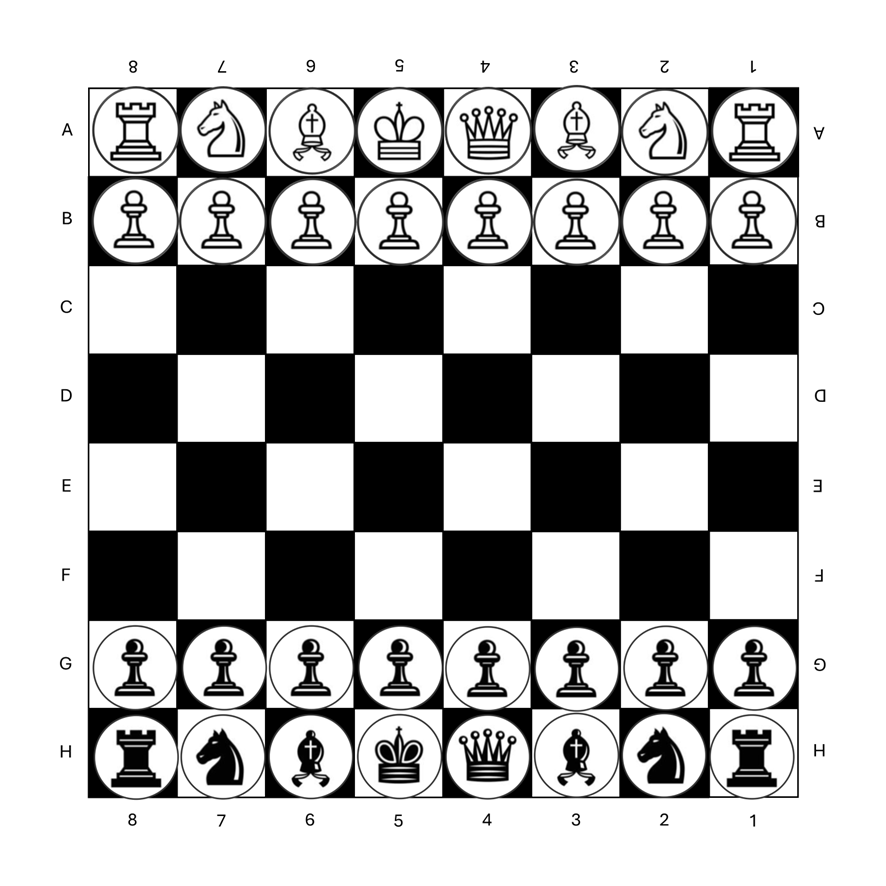
On a Regular Chess Board, the starting positions match the diagram above.
On a larger board, the Chess Army with either be centralized (If an even number space board like a 10×10 board), or offset closer to the 1 column (in a 9x9board, they would start at A1, or I1 for example).
Chess is the default, and Examples on each army will include the Chess army as an example to placement.


 Baldwin Games
Leave a reply to Dou Shou Qi – Welcome to the Jungle – Baldwin Games Cancel reply