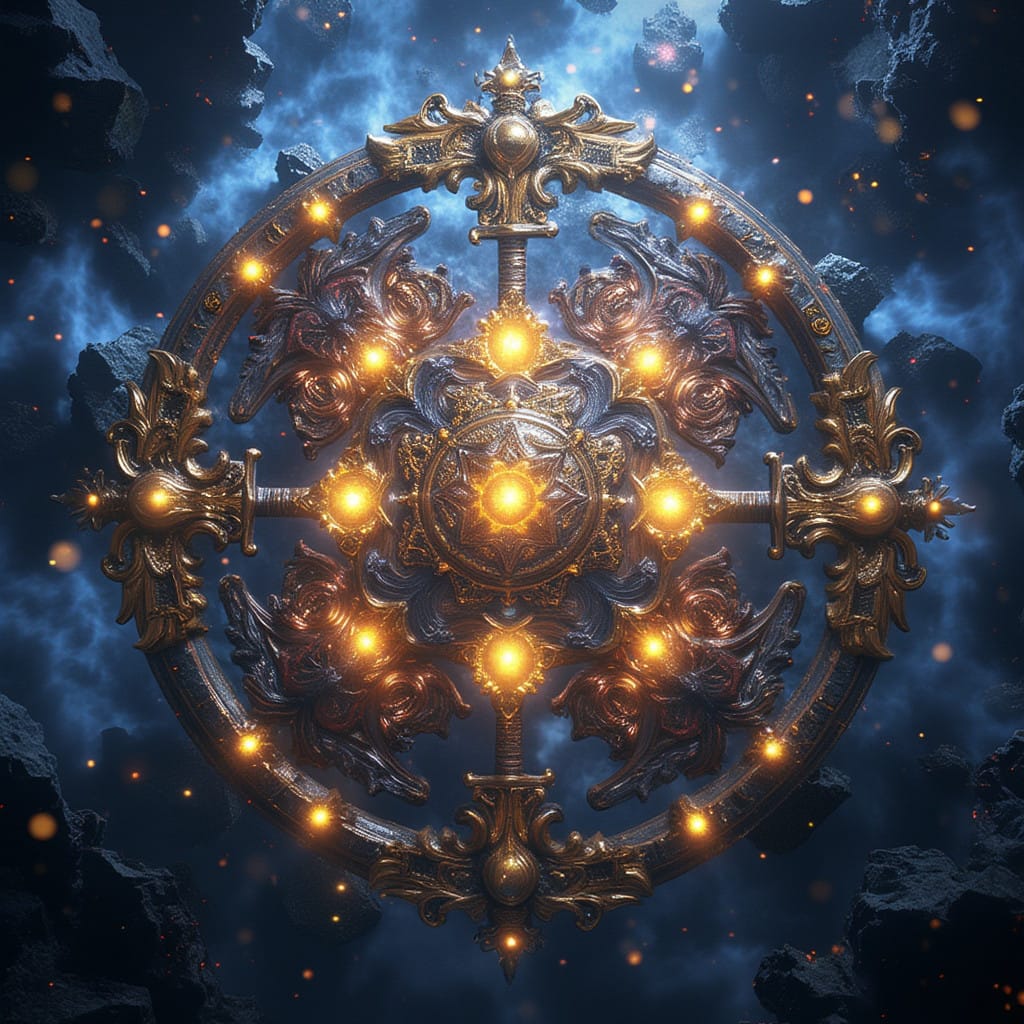
Chess is an ancient game, and as so, it has spread around the world. But it spread around the world, about Hundreds of years ago, Chess came to China, and was adapted to local style. around 700AD Xiang Qi Emerged.
Xiang Qi is the Chinese version of Chess. It is played on a board that has an 8×8 grid on it. Unlike western chess, the grid is not colored in. There is a “River” bisecting the board into 2 fields. Also unlike western chess, the pieces do not start on the boxes of the grid, but rather on the corners of the boxes.

Traditional Xiang Qi is played with wooden discs that have the name of the piece inscribed upon them. Imagine if you will that in stead of the tall majestic piece with a cross on his crown that we have now, we just had a wooden disc that said “king”. that is what is typically used.
Many of the pieces played in Xiang Xi are familiar, and are similar enough to western pieces that once you get past the Chinese writing, you could play easily enough with basic Chess knowledge.


Chariot (Rook)
The Chariot starts at the corners of the boards (a1, a10, I1,I10) Chariots move just like Rooks do in western Chess. They may move Orthogonally any number of spaces. (Straight up a column, or across a row). No changes here.


The Horse (Knight)
The Horse starts right beside the Chariots, just like in western chess. (B1, B10,H1,H10) The Horse moves just like a western chess Knight with one exception. The Horse cannot leap over other pieces in its way. It moves one space orthogonally, and then 1 space diagonally. If the first space is occupied, it may not move, if the 2nd space is occupied by an enemy, it will capture it.


The Minister (Elephant)
The elephant is believed to be the precursor to the bishop. They start next to the Horses (C1,C10,G1,G10). The elephant must move 2 spaces diagonally in the same direction. It cannot turn after one space. Elephants cannot cross the river, so their movement is very limited.


Guards (Advisors)
In the center of each side is a small square with an X in it. this area is the Palace of the King (or General). The guard moves 1 space diagonally. But it may never leave the palace. Here it must protect the King. They begin on the outer back corners of the palace.



General (King)
The General or the King, while very limited in movement, is the most important piece. Like in wester chess, if he is captured, the game ends. You must warn the other player that the king is in “Check” just like in chess. The King may move 1 space orthogonally, in the palace only.
The 2 Kings may never face each other without a piece between them. This is illegal. I like to think of it as in a Kung fu Movie. The King becomes open, so the opponent king leaps over the entire army’s heads, and slays the exposed king. He begins in the exact middle of the back row of pieces.


Cannons
A unique piece to Xiang Xi and other Asian Chess variants. The cannon moves exactly like the rook. But Cannons cannot capture like rooks. If a cannon wishes to capture a piece, it must first, jump over another piece, then move into the piece it wishes to capture. Imagine it being shot into the air over the head of someone and landing on the victim. Cannons begin 2 spaces in front of the Horses. (B3,B8, H3,H8)


Soldiers (Pawns)
Just like in chess, pawns move forward 1 space. Once a Pawn crosses the river successfully, it may choose to move either 1 space forward or 1 space left or right. Unlike western pawns, these pawns capture using regular movement. there are 5 pawns, starting at A4, C4, E4, G4, I4 / A7, C7, E7, G7, I7.
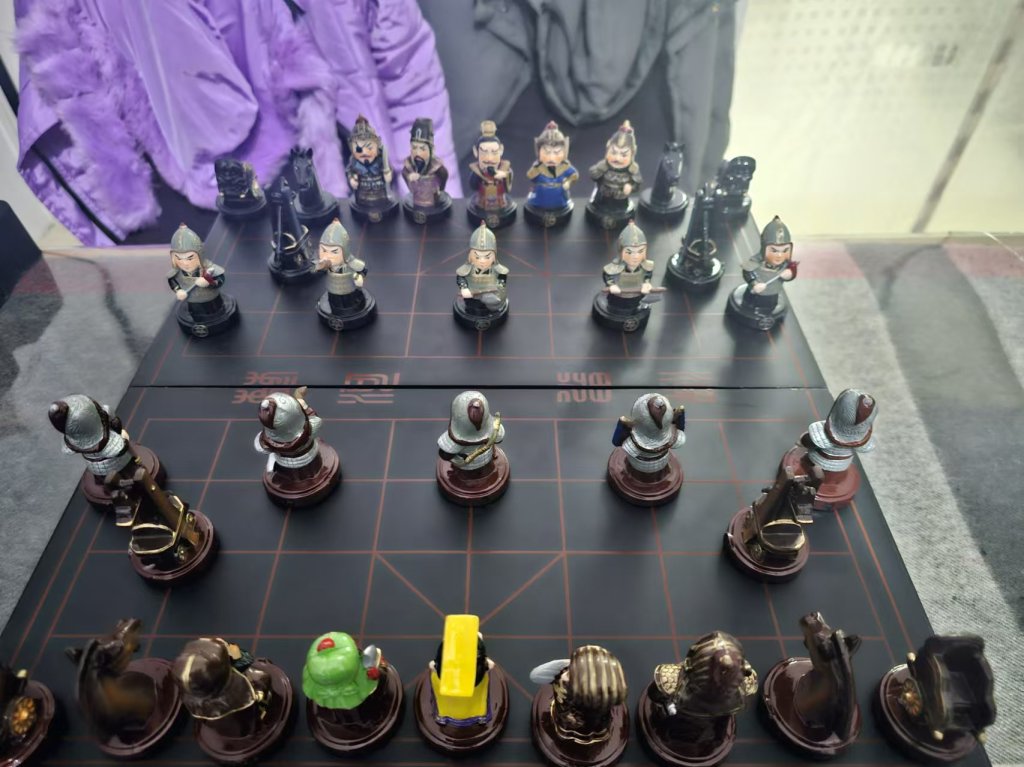
Note: Since My mind shuts down while trying to decipher Chinese characters, I have a couple of sets with figurines. I love to play using them.
Playing without the official Set
So there are a few reasons you may want to try this game at home with a regular chess set. for the most obvious, you cannot buy it nearby. (Probably true for my friends in the western world.) but maybe you can buy it, but just get lost with all of the Chinese writing on the pieces. (Yes Korean Chess has Chinese on their pieces, but not exactly the same writing as in Chinese Chess….)
You should be able to play it with a little work. Here’s what you need:
- 2 visibly different chess sets.
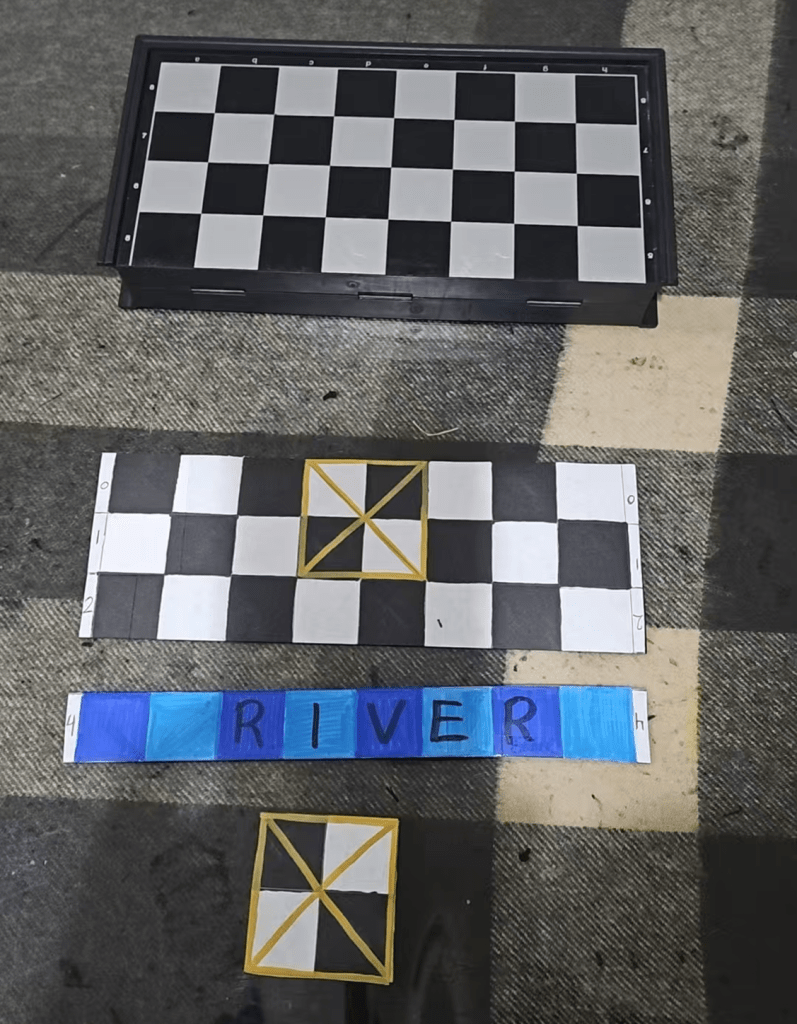
- a way to extend the board 1 more row.
I use magnet paper & labels. - Markers. (to make the palace and River)
I made a magnetic palace for 1 side, and included the palace on the other extension. I then made a river for the middle using colors.

Playing a XiangQi Army in Chess War.
If you wish to play this army in Chess war, you need to make sure your board has space for 9 pieces across. You may play off the intersections, like in the original game, or you may expand the board to have 9 across. either way you need to have a clearly marked palace for your king & Guards.
Otherwise it fits well into Chess War.
Below are printable cards you may use to remember how to play each piece, they are designed for Chess War, but you may use them in the basic game too.

 Baldwin Games
Leave a comment