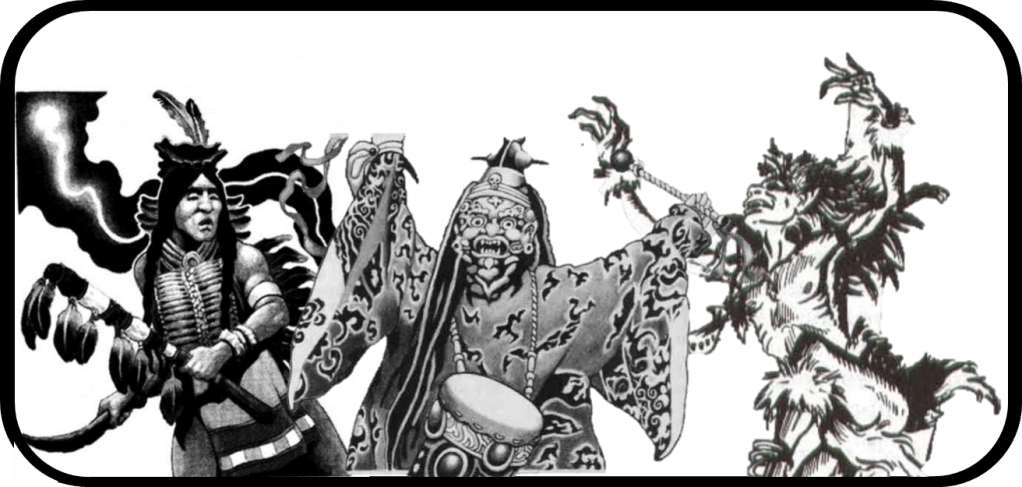
Shamans were written originally as a way to include monsters that could cast cleric & druid spells. It was a way to expand the world of BECMI. They were partnered with Wicca who would be the “Magic Users” for monsters. But no details were really given about what these would look like in the game, just “The Orc turns and casts Protection from Good.”
It was assumed (or at least I assumed) that Shamas would still be priest like (Or witch-doctor like), and Wicca would be more wiseman like. (Similar, but different), but Spellcasters gained extra hp based upon their spellcaster levels.
The original idea was expanded upon in Gaz 10: The Orcs of Thar. In which they explained them as more like primitive priests. This made them identical as the Wicca, except the spell list they could choose from.
Both Shamans and Wicca had to spend 1 experience level in apprenticeship to an elder of the class. After this time, they must go through a Rite of Passage that causes a personal sacrifice (either Constitution loss, or Hp Loss)
Both of these Spellcasters needed a gri-gri, a special scepter, or necklace or spellcasting focus of some sort built by the spellcaster before they finish their apprenticeship. (the example is a skull on a stick with pebbles inside to rattle with feathers). The gri-gri contains the part of the sould (hp or con) lost in the Rite of Passage. and Any lost or broken Gri-gri must be replaced by the Rite of Passage (and loss of life force again).
Th offset this, Shamans and Wicca could make magical amulets (Limited power). Shamans however, could gain the special clerical abilities gained from an Immortal, except the Turn Undead feature. They gained spellcasting at 2nd Shaman level (as clerics gained spells at 2nd level also)
The topic was revisited in PC1: Tall Tales of the Wee Folk, where they removed the Personal Sacrifice and the Gri-Gri from the shamans. Again, Non-Human Characters could become Shamans, and could learn to cast Clerical (or Druidic) spells. They Rite of Passage changed to a personal Role-Playing point, recommended to be set up by the Player and the DM. And then a simple ability check is made.
The Same year, that Tall Tales came out, Gaz 12: The Golden Khan of Ethengar came out. And this had rules for a human Shaman class. This one had Spirit Guardians, each that granted special powers and abilities. These Shaman need their drums to cast spells, like the Gri-gri, but their soul is not part of the drum.
Two Years later Gaz 14: The Atruaghin Clans was released with the Shamani, which was mechanically back to being the basic Humanoid Shaman, but for humans. The only real difference, was some abilities to recognize plants, and that Animals would never harm a Shamani.
When the Mystara Player’s Guide for 5E, Mr, Welch placed the Human Classes as Subclasses. (Shamani as Cleric Domain, and “Spirit Shaman” as Druid Circle) but the Humanoid Shaman disappeared entirely.
I present the Different Rules Below for you as they were written by Bruce Heard, Aaron Allston, John Nephew, Carl Sargeant, Jim Bambra, William Connors, and Glen Welch.
Non-Human Shamans (BECMI)
Prime Requisites: Wisdom
Hit Dice: Same as Race-Class
Maximum Level: by Race-Class
Armor: Same as Race-Class
Weapons: Same as Race-Class.
Special Abilities: Shaman spells, Make Amulet
Humanoids, and other Non-Humans usually do not have clerical classes. Instead, they have more primitive spell casters, the shamans. Their power is no match for conventional clerics described in the game rules, but they may prove useful in many situations, and they do add an interesting twist to role-playing.
These special classes are available to players, starting at any level, with some limitations and conditions.
Apprenticeship & Initiation
To become a shaman, the apprentice must become a subordinate of another Shaman. Shamans require a Prime Requisite of 9 in Wisdom. Shaman abilities can be gained as early as 1st level. Whelps, youngsters, and teenagers have to study until they become 1st-level monsters. Apprenticeship must last at least one full level advancement period (the time between the moment the apprentice reaches one level to the next).
In addition, before the 1st level can be reached, a specific Ritual of Passage or Initiation must be undergone. This ritual typically Involves fasting, intense meditation, perhaps isolation; it may also be necessary to quest for sacred items of nature that are gathered together in a sanctified pouch to make the shaman’s “holy symbol.” The specific nature of the Ritual of Passage is prescribed by the initiate’s mentor (that is, the DM), or, in the case of a treant, by the initiate himself.
To determine if the Ritual was successful, make an Ability Check vs. Wisdom. If the Check fails, so does the Ritual. The 1,000 Experience Points for 1st-level spellcasting are lost, and the character must earn them again in order to attempt the Ritual again. However, if three attempts to begin a spellcasting career fail, then the creature cannot become a spellcaster by any means in future. Further rituals will be fruitless.
Note that the character’s hit points and combat abilities are unchanged. A shaman may, however, save as a cleric of the same level, if these saving throws are better than the character’s normal saving throw scores.
If the Ritual or Initiation is successful, two things may occur: 1) if your character is from a cultured species. (i.e. can read and research) they learn the rituals and customs of the church and become a Shaman. 2) if your character is from a barbaric species or culture (i.e. cannot read) they must make a sacrifice to their Immortal to gain the powers of a Shaman. They would roll on the chart below.
| 1d12 | Effect |
|---|---|
| 1~6 | Character loses 1hp permanently. The Immortals are pleased with the ritual. No further effect. |
| 7~9 | Character loses 1d4 hp permanently. The ritual left scars on the character’s body, but it was rewarding after all. Increase total accumulated experience 5%. |
| 10~11 | Entity comes from beyond and takes a payment. Character loses 1 point of Constitution permanently. The ritual took a heavy toll on the character’s health. Increase total accumulated experience points 10%. |
| 12 | Omen from the Immortals. Character loses 2 points of Constitution in exchange for an extra point of Wisdom up to a maximum of 16. No further effect. |
| Shaman Level | XP | Spells Lv1 | Spells Lv2 | Spells Lv3 | Spells Lv4 |
|---|---|---|---|---|---|
| 1 | +1,000 | – | – | – | – |
| 2 | +2,000 | 1 | – | – | – |
| 3 | +4,000 | 2 | – | – | – |
| 4 | +8,000 | 2 | 1 | – | – |
| 5 | +16,000 | 2 | 2 | – | – |
| 6 | +32,000 | 2 | 2 | 1 | – |
| 7 | +64,000 | 3 | 2 | 2 | – |
| 8 | +130,000 | 3 | 3 | 2 | 1 |
| 9* | +260,000 | 3 | 3 | 3 | 2 |
Example: Troondh is a 3rd-level kobold with 1st-level shaman abilities. A normal kobold needs 2,000 XP to reach level 4. Instead, Troondh needs 4,000 XP (2,000 + 2,000) to become a 2nd-level shaman, for a final total of 7,000 XP. Once a character gains his 1st-level shaman abilities, he must continue his career alone. He does not have a teacher for any of his subsequent levels (see Spell Casting for details on how to gain new spells).
Level Limitations
As described in the Master DM’s Book, shamans have level limitations. It is, however, possible to go beyond these limitations by rolling on the Personal Sacrifice Table each time a new level is gained.
Example: Gumbar is a 2nd-level ogre with 2nd-level spell casting. He decides he wants to become a 3rd-level shaman. At the time he reaches his 3rd level, Gumbar rolls on the Personal Sacrifice Table.
The character may decide to stop improving spell casting skills at some point in his career. This is an important choice. Once this decision is made, it is final and irreversible; the character does not gain any further spell casting powers.
The experience needed for subsequent levels should remain the same as for a normal humanoid from then on. Do not forget to recalculate the experience table for that character.
Example: Troondh is an 8th-level kobold with 4th-level spell casting. He decides to stop his quest for magical power. Troondh now needs only 60,000 XP to reach 9th level (120,000 – 60,000), instead of 76,000 XP (60,000 + 16,000) as would be the case for a 5th-level spell caster.
Spell Casting
Barbaric Shamans recover their spells by dancing, shouting, howling, and waving gri-gris. This replaces the clerical meditation and prayer, since shamans are not necessarily literate. Cultured Shamans recover spells through meditation.
The Shaman automatically knows the spells listed below when reaching each new level
Acquiring New spells
Other spells than those given in this list may be acquired through special rituals, and the expenditure of appropriate spell components. For example, fresh troll blood might do for a reincarnation spell, fur from a displacer beast for a teleport, red dragon scales for protection vs. fire, and so on. A quest is usually needed to acquire these rare items.
Common Spells: Common spells are spells listed in the D&D rulebooks. The spell caster must roll on the Personal Sacrifice Table, and sacrifice treasure at the rate of 1,000 gp per spell level. The rituals to acquire new spells last as long as a day per 1,000 gp of sacrificed treasure! At the end of the ritual, the treasure is destroyed (thrown into a volcano, or disintegrated through dark incantations, or whatever sounds dramatic to you).
New Spells: To acquire new spells (invented by the player), not only must the spell caster make the Personal Sacrifice, but its effects are doubled, as well as the amount of treasure needed.
Chances of Success: Even so, the spell caster is not assured of success. Chances of acquiring spells are as follows:
Common Spell: ((Wis + Lvl) x 2) – (3 per spell level)
New Spell: ((Wis + Lvl) x 2) – (5 per spell level)
As a DM, feel free to give bonuses to the chances of success if the spell caster sacrifices extremely valuable treasure or magic items. Artifacts cannot be used as sacrifices. No matter what the result of the ritual, the treasure is destroyed and the spell caster suffers the effects of the Personal Sacrifice Table.
Casting Spells
Unlike other spell casters, shamans must use a gri-gri or Holy Symbol to cast their spells. This special item must be built before gaining 1st-level spell casting abilities. Shamans are incapable of casting spells without it.
For example, a skull mounted on a stick, with small pebbles inside to make a rattling noise, plus feathers, paints, and other strange elements would make a perfect gri-gri for an orc! In the case of a harpy, this might require carving the item from the thigh bone of an elf killed and eaten by the harpy herself.
Upon performing the Ritual of Passage, shreds of the spell caster’s soul are sent to the gri-gri or Holy Symbol. This item is specially attuned to its owner. No one else can use it. The owner can sense its presence and its exact location within 100 feet.
If the gri-gri is lost, the spell caster must create another by going through the Ritual of Passage once more. A shaman may have any number of gri-gris. Unfortunately, the spell caster permanently loses 1d4 hit points if any of his gri-gris are destroyed.
Creating Amulets
Shamans have very limited abilities when it comes to creating magical items. However, they can create amulets for themselves or others. Special components are required to create amulets. These items have limited powers, as described below:
+/- 1 to Combat (to hit rolls)
+/- 1 to Armor Class
+/- 1 to Damage
+/- 1 to Saving Throws
+/- 1 to an Ability Check (choose Strength, Intelligence, Wisdom, Dexterity, Constitution, or Charisma).
If the amulet is for the spell caster’s use, roll on the Personal Sacrifice Table. Treasure of at least 5,000 gp must be sacrificed in the process. The chances of success are equivalent to acquiring a 5th-level common spell if the spell caster has already created a similar item before. If not, treat as a 5th-level new spell.
If the amulet is for someone else, the effects of the Personal Sacrifice Table apply to him instead. In both cases, the item is attuned to its owner, like the gri- gri. If the amulet is destroyed, the owner suffers a permanent loss of 1d4 hit points.
Effects of the amulets can be accumulated up to +/-5. Any humanoid in his right mind would, however, avoid having too many of these strange items. Do not forget that each of them is a receptacle containing a bit of its owner’s soul. These are tempting little devices for evil entities of the outer planes.
Creating amulets does not produce any experience for the shaman, except when created for himself, and only for the first time a particular type of amulet is created. Experience is equal to 1 XP per 1,000 gp value of sacrificed treasure.
Owning Excessive Amulets
If a character owns more than one, there is a 1% chance per existing amulet of catching the attention of an outer planes entity. The roll is made each time one of the amulets is used. If the roll fails, the entity appears and attempts to take one or more amulets away.
If it takes amulets, the entity will try to possess the owner. Each day, the owner must save vs. Spells at -1 per stolen amulet, or fall under the entity’s control. The only way of freeing a victim is by destroying the amulet(s) the entity tampered with.
Shamans and the Immortals
Shamans are equivalent to conventional clerics, although they do not have the Undead Turning ability. They worship ancient heroes who reached Immortality.
There are more Immortals than can realistically be listed here, and there is no obligation for a shaman to worship the Immortals of their race, and even less so for a regular character to worship anything at all. An orcish shaman could be the follower of a bugbear Immortal if it so fits your campaign.
Spells Usable by Non-Human Shamans:
| 1st Lv Clerical | 2nd Lv Clerical | 3rd Lv Clerical | 4th Lv Clerical | 5th Lv Clerical | 6th Lv Clerical |
|---|---|---|---|---|---|
| Cure Light Wounds* | Bless* | Continual Light* | Cure Serious Wounds* | Create Food | Cureall |
| Detect Magic | Hold Person* | Cure Blindness | Dispel Magic | Cure Critical Wounds | Find the Path |
| Light* | Snake Charm | Cure Disease* | Neutralize Poison* | Dispel Evil | Speak with Monsters* |
| Protection From Evil | Speak with Animals | Remove Curse* | Speak with Plants | Insect Plague | Word of Recall |
Human Shamans (BECMI)
Prime Requisites: Wisdom
Hit Dice: 1d4 per level up to 9th level. Starting with 10th level, +1 hit point per level, and Constitution adjustments no longer apply.
Maximum Level: 36.
Armor: They May not use metal armor or shields
Weapons: Swords, and Bludgeoning weapons.
Special Abilities: Shaman spells, Spirit Guide, Plus variable.
Kaunchi, a shaman, introduces us to the ways of the spirits:
“The World Yurt was made by the Immortals. That is obvious, for how else could it have come to be? The Immortals have many forms and all are mighty. We, the people of the Sea of Grass, know that only by honoring the Immortals and the spirits who serve them can we expect to live the way the Great Ones intended.
“Clerics of other lands are not wrong in their beliefs. Their Immortals give them strength and so the rightness of their ways are proven. The druids of the southern lands are also powerful. and are attuned to the ways of the world.
“All beings have a place. Does not the lion hunt to preserve the balance of nature and we in turn hunt the lion so that we may gain its strength? All is one, and one is all. That is the way of the world.
“The way of the shaman is not a path we choose, we are born with it, and it grows within us. The time comes when the spirit within us makes itself known. It is not a welcome gift, for it brings the illness with it. In this time we fall into a trance for as long as nine days. It is then that we become aware of our spirit guide, the spirit that leads us through life and enables us to enter the Spirit World.
“Because of our knowledge of the spirits, our advice is sought in such things as when is the best time is to make and break camp, to warn of natural disasters, and to determine the best time for organizing hunts and to make war. We are also the memory of our people, the story-tellers who relate the tales of the Great Khans and of the Spirit Lords.
“It is our task to keep the world strong and to guide our people along the best path to the World Mountain. More than this we cannot do, and more than this no one should ask.”
Shamans are similar to clerics—they have the same saving throws and combat tables. Player character shamans are Neutral, but NPC shamans of Chaotic alignment do exist. Shamans have no power over the undead. They may not wear metal armor or use shields. They may use swords in combat.
Spirit Guides: Every shaman has a spirit guide that is determined during character creation, either by random roll, player choice, or by the DM assigning it to your character. The spirit guide is an animal spirit from the Spirit World that usually resides about the shaman’s person—in the drum, drumstick, trinkets, pouches, etc. A spirit guide can only be seen by the shaman. It provides the shaman with knowledge of the Spirit World, spell abilities, and the ability to see other non-materialized spirits (on a successful Spirit Lore check).
Shamans experience an illness when their spirit guide first appears. During the illness the shaman suffers a minor disability that marks the shaman throughout the rest of his life.
Roll 1d6 and consult the following table to see which ability is affected. The character loses 1 point from the ability score and suffers a slight disability. The lost point may be restored by the presence of the spirit guide, but the disability remains.
| 1d6 Roll | Disability |
|---|---|
| 1 | Strength: thin or wasted looking, stringy arms or legs |
| 2 | Intelligence: drooling, nose picking, moronic cackle, etc. |
| 3 | Wisdom: brash, insulting, stubborn, etc. |
| 4 | Dexterity: twisted hands, legs. back, etc. |
| 5 | Constitution: pallid complexion, unhealthy looking |
| 6 | Charisma: twisted face, high-pitched voice, pimples, large colored mark on face, pock-marked face, etc. |
A spirit guide also gives a shaman certain benefits, as shown on the following table.
| 1d20 Roll | Animal Spirit | Attribute | Skill / Advantage |
|---|---|---|---|
| 1 | Horse | +1 Strength | Equestrian |
| 2 | Eagle | +1 Strength | Alertness |
| 3 | Yak | +1 Strength | Muscle |
| 4 | Hawk | +1 Intelligence | Keen Eyesight* |
| 5 | Wolf | +1 Intelligence | Tracking |
| 6 | Snake | +1 Intelligence | Mysticism |
| 7 | Owl | +1 Wisdom | Codes of Law and Justice |
| 8 | Dog | +1 Wisdom | Gain Trust |
| 9 | Gerbil | +1 Wisdom | Danger Sense |
| 10 | Falcon | +1 Wisdom | Falconry |
| 11 | Tiger | +1 Dexterity | Instinct |
| 12 | Cat | +1 Dexterity | Survival |
| 13 | Monkey | +1 Dexterity | Escape Artist |
| 14 | Camel | +1 Constitution | Navigation |
| 15 | Goat | +1 Constitution | Decieve |
| 16 | Bear | +1 Constitution | Wrestle |
| 17 | Sheep | +1 Constitution | Nature Lore |
| 18 | Lion | +1 Charisma | Keen Hearing* |
| 19 | Swan | +1 Charisma | Detect Deception |
| 20 | Chameleon Lizard | +1 Charisma | Disguise |
Bonuses to attributes cannot make an ability score higher than 18. Skill benefits are in addition to the skills that all characters are entitled to.
Shaman Advantages
Keen Hearing: Increases a shaman’s chance of hearing noise to 1-3 on 1d6.
Keen Eyesight: Increases a shaman’s chance of finding secret doors or other hidden objects to 1-2 on 1d6. It also increases by 50% the encounter range at which the shaman notices creatures or landmarks.
Animal Language: Shamans may converse with animals of the same species as their spirit guides, as though using the 2nd-level clerical spell speak with animals.
For every four levels of experience, the shaman may use this power once per day. At 1st through 4th level, a shaman may do this only once per day Each use of the power lasts for an hour, so a shaman of 9th through 12th level can converse for three hours per day.
Shapechange: At 12th level a shaman is able to shapechange into the form of his spirit animal guide. The shaman may shapechange at will. but the transformation takes an entire round, during which the shaman may do nothing else. While in animal form the shaman may not cast any spells, but any spells already cast stay in effect.
The shaman takes on the form of the animal in question and all of its abilities (a shaman who shapechanges into a falcon can fly). Shamans are also able to move 50% faster than the animal normally does.
The shaman has all the attack forms of the animal, but uses the character’s own to hit rolls, plus any penalties or bonuses for Strength, which also apply to damage rolls. The shapechanged shaman ‘s Armor Class is the same as that of the animal, but Dexterity bonuses and penalties still apply. The shaman’s hit points are unchanged. While shapechanged, the shaman’s equipment (armor, weapons, etc.) is transferred to the Spirit World where it is guarded by a spirit animal.
The equipment normally reappears when the shaman returns to his natural form, but evil spirits have been known to steal a shaman’s equipment from its Spirit World location.
The shapechanger appears as an animal of the species in question. A successful Spirit Lore check or a truesight spell will reveal the presence of the shaman.
Shamanistic Beliefs
A shaman mediates between the Ethengars and the Spirit World, striving to keep the World Yurt in harmony with the Spirit World. Shamans ensure that animals are not killed unnecessarily, that suffering is not inflicted on animals, and that the spirits of the World Yurt are appeased, Shamans are not opposed to hunting, but they seek to prevent hunts that greatly reduce the animal population. All hunts are carried out with the consent of a shaman who watches over the proceedings and intervenes if the hunters kill too many animals.
A shaman’s knowledge of the spirits enables him to know whether a site is suitable for a camp and what rituals are required before a camp is made.
The spirit guide acts as the conscience of the shaman. evincing displeasure if the shaman does not behave in manner that fits the character’s shamanistic beliefs. A spirit guide may show its disfavor by withholding some benefits, spells, or by reducing the shaman’s spellcasting abilities. These powers may be returned only after the shaman has performed a dangerous quest or carried out actions to appease the spirit guide. Your DM will tell you what your character must do to recover good standing.
A spirit guide always stays with the shaman. It cannot be made to leave by any means. The only time a spirit guide takes on a materialized form is when the shaman enters the Spirit World- The spirit guide then appears as an intelligent animal of its species. Your DM will tell you what happens when your character enters the Spirit World for the first time.
| Shaman Lv | XP | Lv1 Spells | Lv2 Spells | Lv3 Spells | Lv4 Spells | Lv5 Spells | Lv6 Spells | Lv7 Spells |
|---|---|---|---|---|---|---|---|---|
| 1 | 0 | – | – | – | – | – | – | – |
| 2 | 1,600 | 1 | – | – | – | – | – | – |
| 3 | 3,200 | 2 | – | – | – | – | – | – |
| 4 | 6,500 | 2 | 1 | – | – | – | – | – |
| 5 | 13,000 | 2 | 2 | – | – | – | – | – |
| 6 | 27,500 | 2 | 2 | 2 | – | – | – | – |
| 7 | 55,000 | 3 | 2 | 2 | – | – | – | – |
| 8 | 110,000 | 3 | 3 | 2 | 1 | – | – | – |
| 9 | 220,000 | 3 | 3 | 3 | 2 | – | – | – |
| 10* | 330,000 | 4 | 4 | 3 | 2 | 1 | – | – |
| 11* | 440,000 | 4 | 4 | 3 | 3 | 2 | – | – |
| 12* | 550,000 | 4 | 4 | 4 | 3 | 2 | 1 | – |
| 13* | 660,000 | 5 | 5 | 4 | 3 | 2 | 2 | – |
| 14* | 770,000 | 5 | 5 | 5 | 3 | 3 | 2 | – |
| 15* | 880,000 | 6 | 5 | 5 | 3 | 3 | 3 | – |
| 16* | 990,000 | 6 | 5 | 5 | 4 | 4 | 3 | – |
| 17* | 1,100,000 | 6 | 6 | 5 | 4 | 4 | 3 | 1 |
| 18* | 1,210,000 | 6 | 6 | 5 | 4 | 4 | 3 | 2 |
| 19* | 1,320,000 | 7 | 6 | 5 | 4 | 4 | 4 | 2 |
| 20* | 1,430,000 | 7 | 6 | 5 | 4 | 4 | 4 | 3 |
| 21* | 1,540,000 | 7 | 6 | 5 | 5 | 5 | 4 | 3 |
| 22* | 1,650,000 | 7 | 6 | 5 | 5 | 5 | 4 | 4 |
| 23* | 1,760,000 | 7 | 7 | 6 | 6 | 5 | 4 | 4 |
| 24* | 1,870,000 | 8 | 7 | 6 | 6 | 5 | 5 | 4 |
| 25* | 1,980,000 | 8 | 7 | 6 | 6 | 5 | 5 | 5 |
| 26* | 2,090,000 | 8 | 7 | 7 | 6 | 6 | 5 | 5 |
| 27* | 2,200,000 | 8 | 8 | 7 | 6 | 6 | 6 | 5 |
| 28* | 2,310,000 | 8 | 8 | 7 | 7 | 7 | 6 | 5 |
| 29* | 2,420,000 | 8 | 8 | 7 | 7 | 7 | 6 | 6 |
| 30* | 2,530,000 | 8 | 8 | 8 | 7 | 7 | 7 | 6 |
| 31* | 2,640,000 | 8 | 8 | 8 | 8 | 8 | 7 | 6 |
| 32* | 2,750,000 | 9 | 8 | 8 | 8 | 8 | 7 | 7 |
| 33* | 2,860,000 | 9 | 9 | 8 | 8 | 8 | 8 | 7 |
| 34* | 2,970,000 | 9 | 9 | 9 | 8 | 8 | 8 | 8 |
| 35* | 3,080,000 | 9 | 9 | 9 | 9 | 9 | 8 | 8 |
| 36* | 3,190,000 | 9 | 9 | 9 | 9 | 9 | 9 | 9 |
Appearance
Shamans either dress in clothing made from their totem animal, or they wear items derived from the animal. The spirit guide of any shaman is therefore obvious by looking at the shaman.
Shaman with horse spirit guides are likely to have horse tails attached to their hats, tunics, and skirts. One with a tiger spirit guide is likely to wear a tiger skin cloak, etc.
To emphasize their relationship to the spirits. shamans often paint their faces with fierce designs, giving the impression of extremely slanted eyes and hollow cheeks. To add to their fierce appearance, long fangs are drawn at the sides of their mouths, which they outline in red ochre.
Casting Spells
Each shaman must have a drum to cast spells. When casting spells, the shaman beats the drum with the drum stick and chants loudly. There is no such thing as a silent shaman spell caster!
Shamans may cast any of the following spells, as their spirit guides empower them with the correct knowledge once they attain the required level. Shaman spells are never found on scrolls.
Each spell in the lists below is followed by a reference to the full description of the spell. RC=Rules Cyclopedia; S=Shaman spells (Here). Page numbers are given for each rule set.
| Lv1 Spells | Lv2 Spells | Lv3 Spells | Lv4 Spells | Lv 5 Spells | Lv6 Spells | Lv7 Spells |
|---|---|---|---|---|---|---|
| Command Word (S) | Bless* (RC35) | Continual Light* (RC36) | Control Temp. 10′ Radius (RC42) | Commune with Spirit Lord (S) | Animate Object (RC38) | Creeping Doom (RC43) |
| Detect Poison (S) | Cure Light Wounds* (RC34) | Cure Blindness (RC36) | Cure Serious Wounds* (RC37) | Confound* (S) | Barrier* (RC38) | Earthquake (RC39) |
| Fellowship (S) | Find Traps (RC35) | Cure Disease* (RC36) | Dispel Magic (RC37) | Control Winds (RC42) | Cureall (RC38) | Holy Word (RC39) |
| Light* (RC34) | Hold Person* (RC35) | Detect Curse (S) | Fate (S) | Cure Critical Wounds (RC37) | Find the Path (RC39) | Metal to Wood (RC43) |
| Locate (RC41) | Produce Fire (RC41) | Hold Spirit (S) | Neutralize Poison* (RC37) | Dissolve (RC42) | Maddness (S) | Spell Turning (S) |
| Pass without Trace (S) | Resist Fire (RC35) | Invisibility to Spirits (S) | Protection from Lightning (RC42) | Quest (RC38) | Spirit Storm (S) | Summon Greater Animal Spirit (S) |
| Predict Weather* (RC41) | Shimmer (S) | Locate Object (RC36) | Sticks to Snakes (RC37) | Spirit Walk (S) | Speak with Monsters* (RC39) | Survival (RC39) |
| Remove Fear* (RC35) | Silence 15′ Radius (RC35) | Protection from Poisons (RC42) | Summon Herd (S) | Strength of Mind* (S) | Summon Weather (RC43) | Travel (RC40) |
| Resist Cold (RC35) | Snake Charm (RC | Remove Curse* (RC36) | Summon Lesser Animal Spirit (S) | Sword of Fire (S) | Turn Wood (RC43) | Weather Control (RC43) |
| Trance (S) | Spirit Sending (S) | Silent Move (S) | Vigor (S) | Truesight (RC38) | Word of Recall (RC39) | Wish (RC40) |
Human Shamani (BECMI)
Prime Requisites: Wisdom and Constitution
Experience Bonus: A shamani character with a score of 13 to 15 in both of these attributes receives a 5 % bonus to all experience points awarded for an adventure. If the character has scores of 16 or higher in both of these attributes, the bonus is increased to + 10%.
Hit Dice: 1d6 per level up to 9th level. Starting with 10th level, +1 hit point per level, and Constitution
adjustments no longer apply.
Maximum Level: 36
Armor: No metal armor, non-metal shields allowed.
Weapons: No metal weapons.
The shamani are a powerful, yet humble, people. They are always of lawful alignment and are the most influential of the Children of Atruaghin, for they claim to be in touch with his personal energies. It is through the shamani, the tribes believe, that Atruaghin speaks his will. Thus, the voice of a shamani is always treated with respect, even awe, by any member of the tribes.
Shamani are similar to the clerics of the Known World as they oversee the mystical practices of the Atruaghin Clans. In addition, they have much in common with the mysterious druids that are found in dark and secluded wildernesses. They are not trained in combat, fighting as magic-users, but do manage to keep themselves in shape due to the nature of many of their devotions. Shamani are blessed by Atruaghin and, thus, are able to employ some very powerful magical spells.
Shamani have two prime requisites, just as do the demi-human classes: Wisdom and Constitution. A shamani character with a score of 13 to 15 in both of these attributes receives a 5 % bonus to all experience points awarded for an adventure. If the character has scores of 16 or higher in both of these attributes, the bonus is increased to + 10%. Players and Dungeon Masters should note that the ratio of ability scores to experience point bonuses is not the same for shamani as it is for other human or demi-human characters. Atruaghin demands much of his followers, and even more from their spiritual leaders.
Restrictions: Shamani characters use six-sided dice when determining hit points, just as traditional clerics do. They attack as magic-users, however, being largely untrained in the ways of physical combat.
Shamani are unable to wear armor other than leather, but as this restriction is found throughout the Atruaghin Clans for both cultural and technological reasons, it seldom hinders them in life.
Shamani are unable to use metal weapons in combat, though all others are open to them regardless of type. In almost every case, their choice of weapons is guided by the customs of their particular tribe. More information on this topic will be found in the Referees’ Guide to the Atruaghin Clans under the detailed descriptions of the various tribes.
Unlike most of the clerics in the Known World, shamani are unable to turn the undead. Atruaghin has no particular interest in or revulsion toward these foul creatures, so he grants his people no special powers for confronting them.
Special Abilities: Shamani have a natural affinity for the wild lands of the Known World. Because of this, they are able to tell whether plants and animals are safe to eat after a quick (1 round) examination and to spot unhealthy water on sight. This ability reveals natural poisons, diseases, or any other normally occurring taint but has only a 50% chance of spotting artificial toxins. If artificial toxins have been placed on some consumable by a character with thieving abilities, this chance drops by 2% per level of the poisoner.
Non-magical animals, including giant versions of mundane creatures, will never attack a shamani character. This protection does not extend to those travelling with or near the shamani.
As mentioned earlier, shamani have numerous magical spells available to them. These are granted by Atruaghin with the understanding that the shamani will use them for the betterment of all members of the tribes. Thus, a shamani who turns against his people or fails them may find his magic stripped away from him without warning. Further, the shamani’s spells are vital to many of the ceremonies so important to the daily life of the tribes and he is expected to use his powers for such rituals whenever called upon to do so.
General Skills
This section is intended for those campaigns in which the optional general skills rules are being used. This game system has been detailed in earlier Gazetteers, the HOLLOW WORLD boxed set, and is incorporated in the D&D Rules Cyclopedia, so it will not be detailed here.
Shamani characters are required to devote themselves to their duties from an early age. Thus, many of their skill slots are filled in a specific manner.
First level shamani (that is, all newly created characters) are required to have the following general skills: Knowledge of Atruaghin Clans History, Nature Lore, Honor Atruaghin, and Animal Empathy (Totem Animal). Obviously, this fills up all four of a character’s starting slots.
If the character happens to be blessed with an Intelligence high enough to earn some extra slots at first level, or as he advances in level and acquires additional slots through experience, there are other skills that are recommended for shamani: Fire Building, Healing, Animal Trainer, Endurance, Leadership, and Storytelling. In fact, shamani characters are forbidden to select more than one skill that does not appear on the above list until after they have all of the suggested skills. It takes a long time to learn all of the things that a good shamani must know.
Experience Progression & Spell Availability
Shamani advance in levels just as all other characters do. The following table shows the experience point total required for the character to attain various levels, as well as the number and levels of spells that become available to the character as he becomes more and more powerful.
| Level | XP | THAC0 | Lv1 Spells | Lv2 Spells | Lv3 Spells | Lv4 Spells | Lv5 Spells | Lv6 Spells |
|---|---|---|---|---|---|---|---|---|
| 1 | 0 | 19 | 1 | – | – | – | – | – |
| 2 | 3,000 | 19 | 2 | – | – | – | – | – |
| 3 | 6,000 | 19 | 2 | 1 | – | – | – | – |
| 4 | 9,000 | 19 | 2 | 2 | – | – | – | – |
| 5 | 15,000 | 19 | 3 | 2 | 1 | – | – | – |
| 6 | 25,000 | 17 | 3 | 2 | 2 | – | – | – |
| 7 | 50,000 | 17 | 3 | 3 | 2 | 1 | – | – |
| 8 | 75,000 | 17 | 4 | 3 | 2 | 2 | – | – |
| 9 | 125,000 | 17 | 4 | 3 | 3 | 2 | 1 | – |
| 10 | 200,000 | 17 | 4 | 4 | 3 | 2 | 2 | – |
| 11 | 300,000 | 15 | 5 | 4 | 3 | 3 | 2 | 1 |
| 12 | 400,000 | 15 | 5 | 4 | 4 | 3 | 2 | 2 |
| 13 | 500,000 | 15 | 5 | 5 | 4 | 3 | 3 | 2 |
| 14 | 600,000 | 15 | 6 | 5 | 4 | 4 | 3 | 2 |
| 15 | 700,000 | 15 | 6 | 5 | 5 | 4 | 3 | 3 |
| 16 | 800,000 | 13 | 6 | 6 | 5 | 4 | 4 | 3 |
| 17 | 900,000 | 13 | 6 | 6 | 5 | 5 | 4 | 3 |
| 18 | 1,000,000 | 13 | 7 | 6 | 6 | 5 | 4 | 4 |
| 19 | 1,100,000 | 13 | 7 | 6 | 6 | 5 | 5 | 4 |
| 20 | 1,200,000 | 13 | 7 | 7 | 6 | 6 | 5 | 4 |
| 21 | 1,300,000 | 11 | 7 | 7 | 6 | 6 | 5 | 5 |
| 22 | 1,400,000 | 11 | 8 | 7 | 7 | 6 | 6 | 5 |
| 23 | 1,500,000 | 11 | 8 | 7 | 7 | 6 | 6 | 5 |
| 24 | 1,600,000 | 11 | 8 | 8 | 7 | 7 | 6 | 6 |
| 25 | 1,700,000 | 11 | 8 | 8 | 7 | 7 | 6 | 6 |
| 26 | 1,800,000 | 9 | 9 | 8 | 8 | 7 | 7 | 6 |
| 27 | 1,900,000 | 9 | 9 | 8 | 8 | 7 | 7 | 6 |
| 28 | 2,000,000 | 9 | 9 | 9 | 8 | 8 | 7 | 7 |
| 29 | 2,100,000 | 9 | 9 | 9 | 8 | 8 | 7 | 7 |
| 30 | 2,200,000 | 9 | 9 | 9 | 9 | 8 | 8 | 7 |
| 31 | 2,300,000 | 7 | 9 | 9 | 9 | 8 | 8 | 7 |
| 32 | 2,400,000 | 7 | 9 | 9 | 9 | 9 | 8 | 8 |
| 33 | 2,500,000 | 7 | 9 | 9 | 9 | 9 | 8 | 8 |
| 34 | 2,600,000 | 7 | 9 | 9 | 9 | 9 | 9 | 8 |
| 35 | 2,700,000 | 7 | 9 | 9 | 9 | 9 | 9 | 8 |
| 36 | 2,800,000 | 5 | 9 | 9 | 9 | 9 | 9 | 9 |
Shamani Spell List
Many of the spells employed by the shamani use different rituals and gestures than similar spells used by other character classes. In many cases, however, it is possible to equate a shamani spell with one employed elsewhere in the Known World.
| Lv 1 Spells | Lv 2 Spells | Lv 3 Spells | Lv 4 Spells | Lv 5 Spell | Lv 6 Spells |
|---|---|---|---|---|---|
| Cure Light Wounds* (RC34) | Animal Charm (S) | Call Lightning (RC41) | Bind Totem* (S) | Commune (RC37( | Creeping Doom (RC43) |
| Detect Evil (RC34) | Bless* (RC35) | Call Totem (S) | Cure Serious Wounds* (RC37) | Cure Critical Wounds* (RC37) | Cureall (RC38) |
| Detect Magic (RC34) | Hunting Paint (S) | Cure Disease* (RC36) | Fire Gate (S) | Dispel Evil (RC37) | Infusion (S) |
| Detect Totem (S) | Know Alignment* (RC35) | Dispel Magic (RC48) | Growth of Plants* (RC49) | Eye of the Eagle (S) | Lore (RC55) |
| Minor Blessing (S) | Locate Totem (S) | Firebow (S) | Neutralize Poison* (RC37) | Polymorph Self (RC50) | Quest* (RC38) |
| Predict Weather (RC41) | Resist Fire (RC35) | Hold Animal (RC42) | Sanctify (S) | Totem Mastery (S) | Symbol (RC58) |
| Protection from Evil (RC34) | Speak with Animals (RC35) | Thunder Drum (S) | Speak with Plants (RC37) | Truesight (RC38) | Weather Control (RC43) |
| Purify Food & Water (RC35) | War Paint (S) | Summon Animals (RC42) | Wrath of Atruaghin (S) |
Shamani Subclass (5e Cleric Domain)
The holy men of the Atruaghin Clans, shamani lead their people into rituals, provide for the sick, and tend to the animals. Though they
shun armor and the ability to turn undead, shamani make up for it with
unrivaled healing powers and rituals. Shamani are used by all the tribes of the
Atruaghin Clans, except the Tiger Clan which has long turned to the powers of Entropy. When they have to leave the plateau, they bring the power of their totems with them. Shamani are more in touch with nature than many druids, able to calm wild beasts and even bend their will.
Shamani are typically found in Atruaghin guiding their tribe, but with the plateau opening to the rest of the world, they are becoming more common in other nations. Shamani are found in the Bear, Elk,
Horse, and Turtle Clans and often worship the entire pantheon.
Restriction: Atruaghin only. Shamani cannot use Channel Divinity or domain abilities while wearing metal armor. Shamani cannot use metal weapons.
| Level | Shamani Domain Spells |
|---|---|
| 1st | Animal Friendship, Speak with Animals |
| 3rd | Animal Messenger, Beast Sense |
| 5th | Conjure Animals, Spirit Guardians |
| 7th | Dominate Beast, Locate Creature |
| 9th | Commune with Nature, Gease |
Sense Illness.
Atruaghin despises the use of poison as a weapon and gives his clerics the ability to spot its use easily. At 1st level, shamani can cast Detect Poison and Disease without using a spell slot. Also, you gain proficiency in either Animal Handling or Survival skills.
Channel Divinity: Nature’s Touch
Because of the dangers of Atruaghin, shamani focus on healing over repelling undead. At 2nd level, you can spend a Channel Divinity to increase the range of healing spells (including touch) by 15 feet.
Channel Divinity: Beast Dominance
At 2nd level, you can use Channel Divinity to cause all beasts in 30 feet to make a Wisdom saving throw or be compelled to obey a single word command such as “flee” or “follow.” The animals will follow your command for one minute or until they take damage. The animals cannot be compelled to attack. At 5th level, instead of destroying undead, that ability is replaced by the ability to compel beasts to attack with
Beast Dominance. You can compel animals of a CR rating equal to that of the undead you would normally destroy at that level.
Nature’s Ally
At 6th level, beasts will not attack you unless attacked first. This includes giant versions of beasts. This protection does not extend to your allies.
Spirit Ritual
At 8th level, you can cast any spell available as a ritual a number of times equal to your Wisdom modifier. You cannot perform Spirit Ritual again until after a long rest. You do not need to have the spell prepared. This takes the same amount of time it would take to cast the ritual normally, or one minute per spell level if not stated.
Spirit Master
You have learned all the great rituals and can perform all the needed preparations in a fraction of the time. At 17th level, all rituals take half the time stated. Spirit ritual casts normally now instead of ritual casting time.
Spirit Shaman (5E Warlock Circle)
Considered as terrifying examples of the foreign nature of the Ethengar, their shaman serve as holy men. The spirit shaman gain their powers not from the Immortals, but instead, take guidance from the Spirit Lords. The spirit shaman are more concerned with the spirit world than the mortal world and are known for their eccentric behavior. The spirits talk to the shaman, giving guidance in matters known to the spirit. While the shaman live apart from their people, they are often sought out by the Ethengar who value their wisdom.
Spirit shaman are most often found in Ethengar, where the wall between the physical world and spirit world is thin. The spirits provide aid to the shaman in numerous forms, from whispering secrets into the shaman’s ear to possessing livestock or twisting the forms of the shaman’s enemies.
The shaman are found throughout Ethengar, and have the ear of all the khans. Spirits are most common in Ethengar, so the shaman rarely leave, but sometimes they are directed into other lands. They are considered quite odd, even by Ethengar standards, due to talking to spirits only they can see.
Restriction: Must be Ethengarian
Expanded Spell List
The Knowledge of the Spirit Shaman lets you choose from an expanded list of spells when you learn a warlock spell. The following spells are added to the Warlock list for you:
| Level | Spirit Shaman Expanded Spell List |
|---|---|
| 1st | Alarm, Tasha’s Hideous Laughter |
| 2nd | Enhance Ability, Locate Object |
| 3rd | Bestow Curse, Conjure Animals |
| 4th | Dominate Beast, Polymorph |
| 5th | Commune with Nature, Gease |
Spirit Guide
At 1st level, you can speak the language of the spirit, and they find it impossible to disguise themselves from you. You can speak the languages of spirits and automatically recognize a spirit even if it is disguised or polymorphed.
Invoke Spirit
At 6th level, you can call on spirits to guide you through a task or to help you out when you are in danger. As a reaction to taking a saving throw or before taking a skill check, you gain proficiency in the saving throw or the skill.
Once you use this feature, you can’t use it again until you finish a short or long rest.
Rebuke the Spirits
At 10th level, you can force out unnatural creatures. As an action, you can automatically dismiss any summoned spirits within 30 feet of you. The spirits return to the spirit world. Undead spirits must make a Charisma saving throw or be sent to the negative energy plane.
Spirit Foci
At 14th level, you have become known to the powerful spirit lords, and they are favorable to your summons. When you conjure spirit animals with a spell, they automatically have full hit points.
The Non-Human Shamans were adapted to Player Character use by Bruce Heard in 1989 (Gaz 10: The Orcs of Thar), and then reproduced everywhere.
The Human Shaman was created by Jim Bambra in 1989 (Gaz 12: The Golden Khan of Ethengar).
The Shamani was created by William Connors in 1991 (Gaz 14: The Atruaghin Clans).
The Spirit Shaman, and the Shamani were both Adapted to 5E by Glen Walch (The Mystara Player’s Handbook) (Completion date unknown, sometime after 2016)
 Baldwin Games
Leave a comment